Why this lesson matters
Up to now we've covered theory: how to read signals, manage risk, control psychology. This lesson is different. I'm going to walk you through a complete trade from start to finish — the way it actually happens in real time, not the way it looks in textbooks.
You'll see the decision points, the small judgment calls, the things that don't fit neatly into rules. This is the messy reality of professional trading. Read it carefully.
For confidentiality I'm using a representative example — typical of GP signals you'll see in production. Numbers and conditions reflect a realistic trading day.
The setup — Tuesday, 9:42 AM ET
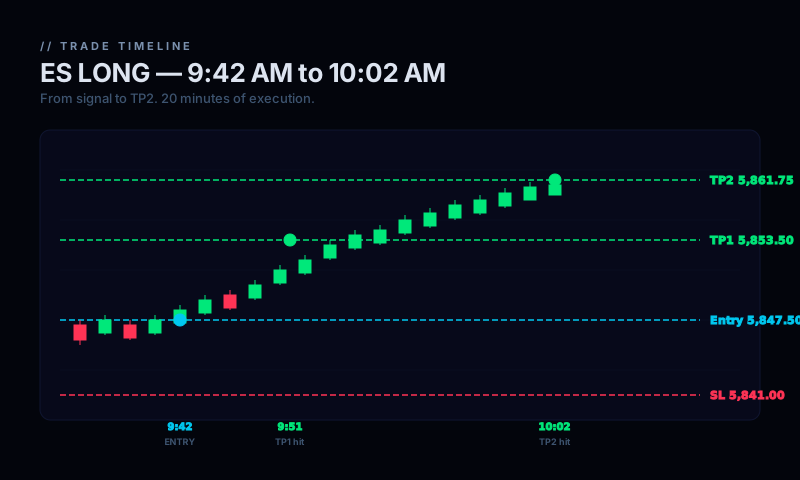
Signal at 9:42 AM. TP1 hit at 9:51. TP2 hit at 10:02. Twenty minutes from entry to full exit.
The pre-market routine is done. Briefing read at 8:00. Bias for today: bullish on ES above 5,840, neutral-bearish below 5,830. Key resistance: 5,855. Key support: 5,840 and 5,830 below it. CPI data already dropped at 8:30 — it was in line with expectations, market settled.
Account: $20,000. Risk per trade: 2% = $400 max loss.
I'm at my desk. Two monitors. Left: TradingView 4-chart layout (ES, NQ, BTC, VIX). Right: Tradovate. ES has been chopping in a 5,843-5,851 range since the open. Slow morning. I'm patient.
At 9:42 AM, my phone buzzes. Telegram alert.
``` 🚨 GP SNIPER PRO ULTRA v3.0 ES LONG | FUTURES Score: 92/100
Entry: 5,847.25 TP1: 5,853.50 (+25 ticks) TP2: 5,861.75 (+58 ticks) SL: 5,841.00 (-25 ticks)
Risk/Reward: 1:2.3 Time: 09:42 ET ```
Decision point 1 — The 15-second checklist
Before clicking anything, I run through my rules. This whole process takes about 12 seconds.
Is the signal aligned with today's bias? Bias is bullish above 5,840. Entry is 5,847.25, well above the bias level. SL is 5,841 — still above the bias invalidation. ✅
Is price still near entry? I glance at the chart. ES is currently at 5,847.50 — half a tick from entry. ✅
Cross-asset check. NQ: trending up, just made new session high 30 seconds ago. ✅ confirmation. BTC: drifting sideways, but not selling. Neutral, doesn't conflict. VIX: 14.20, slightly down. Risk-on environment. ✅
Position sizing. Account $20,000 × 2% = $400 max risk. SL distance: 25 ticks × $12.50 per tick (ES) = $312.50 risk per contract. $400 / $312.50 = 1.28 contracts.
So I'm taking 1 ES contract. I could take 1 + a few MES (micros) to get closer to the full $400 risk, but I keep it simple: 1 ES contract = $312.50 risk. Slightly under 2%. Fine.
Time of day check. 9:42 AM, peak NY session, full liquidity. No data releases coming in the next 60 minutes. ✅
All checks passed. Trade is valid.
Decision point 2 — Order placement
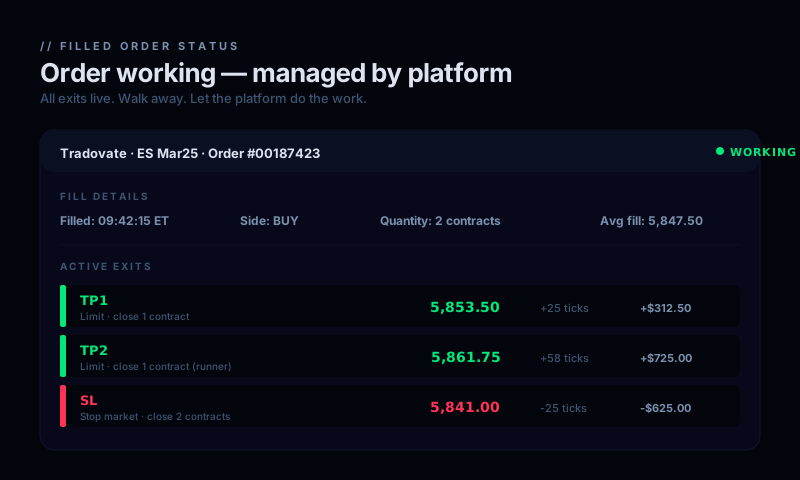
All three exits live. Walk away. The platform does the work.
I open Tradovate. I have a hot-key template set up for ES OCO orders. Click, fill in:
- Quantity: 1 contract
- Entry: Market order (price is already at entry)
- OCO bracket: - Take profit 1: 5,853.50 (close 50% of position) - Take profit 2: 5,861.75 (close remaining 50%) - Stop loss: 5,841.00 (close 100%)
Click confirm. Position is live.
Total time from alert to filled order: about 22 seconds. Not as fast as I want, but acceptable.
I write the trade in my journal app on the second monitor: - Time: 9:42:15 ET - Direction: ES LONG, 1 contract - Entry: 5,847.50 (slipped a quarter tick from signal — fine) - SL: 5,841.00, TP1: 5,853.50, TP2: 5,861.75 - Bias aligned: Y - Cross-asset confirmed: Y - Plan: hold to TP1, move stop to break-even, let runner ride
Now I wait.
The next 8 minutes — managing the trade
9:43 AM: Price ticks up to 5,848. I do nothing. The plan is the plan.
9:46 AM: Price pulls back to 5,846. Below my entry but above my stop. I feel a small twinge of "is this trade going to work." This is the moment FOMO and revenge trading were warning me about. Recognize the feeling. Honor the plan. Don't touch anything.
9:48 AM: Price recovers to 5,849. NQ is making new highs. Cross-asset confirmation holding. Trade is breathing normally.
9:51 AM: ES taps 5,853.50. TP1 hits. Half the position closes automatically. P&L on the closed half: 25 ticks × $12.50 = +$156.25.
I immediately do the most important thing: move the stop on the remaining 0.5 contracts to break-even (5,847.50). Click, confirm. The trade is now risk-free. If price reverses, I exit flat on the runner. If TP2 hits, big winner.
Updated journal entry: TP1 hit at 9:51. Locked in $156.25. SL moved to break-even on runner.
Decision point 3 — The runner
This is where most traders mess up. They either: - Take TP2 mentally and hope it hits, ignoring the chart. - Get bored and exit early "to lock in the win." - Watch every tick and panic-exit on the slightest pullback.
The professional move: set the rules in advance, then mostly ignore the trade. I have my OCO bracket. TP2 will trigger automatically if it hits. SL at break-even will trigger if it reverses. My only job is to update the trailing stop manually as price moves further in my favor.
9:54 AM: ES at 5,856. Halfway between TP1 and TP2. Per my rules, I move the trailing stop from break-even to 5,852 — locking in 4.5 ticks of profit on the runner regardless.
9:58 AM: ES at 5,859. Close to TP2 now. NQ also ripping. I leave the trailing stop at 5,852. Don't get greedy with adjustments.
10:02 AM: ES taps 5,861.75. TP2 hits. Remaining position closes. 58 ticks × $12.50 × 0.5 = +$181.25 on the runner.
Trade complete — the math
Entry: 5,847.50, 1 contract. TP1 exit: 5,853.50 on 0.5 contracts = +25 ticks × $12.50 × 0.5 = wait, let me redo this. ES contract is 1 unit minimum, so 1 contract closing 50% means I closed 1 contract worth of ticks at 25-tick distance, but on half size... actually with 1 contract you can't truly partial out — you'd need 2 contracts for clean halves.
Let me correct that for honesty: with 1 ES contract, you don't partial out — you either exit fully at TP1 or fully at TP2. With 2+ contracts (or using micros), you can do real partials.
Realistic version of this trade with 1 ES: You'd pick one TP based on your trade-management rule. For example, "I take TP1 on choppy days, hold to TP2 on trending days." Today felt trending, so I'd hold to TP2.
With 2 ES contracts and the same setup:
- TP1 exit: 1 contract × 25 ticks × $12.50 = +$312.50
- TP2 exit on runner: 1 contract × 58 ticks × $12.50 = +$725 (with break-even stop, max loss on runner is $0)
- Total best case: +$1,037.50 on $625 risk.
- Total worst case (TP1 hits then runner stops at break-even): +$312.50.
Actual outcome with 2 contracts: TP1 + TP2 both hit = +$1,037.50. That's a +5.2% day on a $20,000 account. From one trade.
Decision point 4 — What I do AFTER the win
This is where many traders blow up. They take a great win, feel invincible, and immediately look for the next trade.
What I actually do:
- Close the chart. I literally minimize TradingView. No more screen.
- Walk away from the desk for 15 minutes. Get water. Stretch. Reset the brain.
- Journal the trade in detail. What worked? What can I do better next time? Was my entry timing optimal?
- Don't take another trade for at least 30 minutes. The high from a winner is just as dangerous as the low from a loser. Both compromise judgment.
If another GP signal fires in that 30-minute window, I evaluate it on its own merits — not relative to "I'm hot today, let me size up." Same risk, same checklist, same rules.
This discipline is what compounds wins into careers.
What if it had gone the other way?
Let's run the alternate timeline. Same setup, but at 9:46 AM, instead of pulling back to 5,846 and recovering, ES drops to 5,841 and triggers my stop.
Outcome: -25 ticks × $12.50 × 1 contract = -$312.50. That's 1.6% of account. Within my risk rules.
What I do: 1. Don't move the stop. It triggers cleanly. I'm out. 2. Check the journal entry. Note the loss. Note the conditions. 3. Walk away for 15 minutes. Same as after a win — the cortisol from a loss compromises judgment too. 4. Don't take "revenge" on the next signal. The next setup is the next setup. Not a revenge opportunity.
If two more signals fire in the next hour and both lose? Three losses in a row → cut size to 1% per Lesson 5's rule. If five losses → done for the day.
Boring on purpose. Boring keeps you in the game.
What separates this trade from amateur trading
Look at what I DIDN'T do:
- I didn't add to the position when it pulled back to 5,846. (Averaging down is not in my system.)
- I didn't move the stop when price approached it. (See Lesson 6.)
- I didn't "scalp" the partial — I let the runner run per the plan.
- I didn't increase size on the next signal because I was hot.
- I didn't watch every tick of the runner anxiously. The OCO managed it.
Now look at what I DID do:
- Pre-trade: ran the 15-second checklist before clicking anything.
- Order: full OCO bracket placed in 22 seconds.
- Management: moved stop to break-even at TP1, trailed at halfway to TP2, let TP2 hit automatically.
- Post-trade: journaled in detail, walked away from desk, didn't immediately re-engage.
That's the whole game. Boring rules, applied consistently.
What I want you to do this week
- On the next 5 GP signals you take, walk through this same checklist explicitly. Time yourself.
- After every trade — win or loss — close the chart and walk away for 15 minutes before re-engaging.
- Practice the trailing-stop sequence (initial → break-even at TP1 → halfway lock → TP2) on every multi-contract trade.
- Journal every trade with the same level of detail as I did here. After 10 trades, review.
- Read Lesson 12 next: Weekly Review and Account Scaling.
Lesson 11 takeaways
- The trade itself is 12 seconds of decisions and 8-30 minutes of waiting.
- 95% of professional trading is the boring part: checklist, OCO, walk away.
- The hardest skill is doing nothing when the trade is breathing — pullbacks aren't signals to act.
- Manage exits in stages: break-even at TP1, lock at halfway, let TP2 hit.
- Walk away after every trade, win OR lose. Discipline isn't tested in the trade. It's tested between trades.
See you in Lesson 12. — GP Trading Club