Why this lesson matters
You made it. You've learned how to read signals, manage risk, control psychology, and execute trades like a professional. Now comes the part that almost no course teaches: how to grow.
Most traders fail at this stage even after they've become consistent. Why? Because growing an account requires a different skill than just trading well. It requires periodic review, intelligent scaling decisions, and the discipline to NOT scale when the urge feels strongest.
This is the final lesson because it pulls everything together. After this, you have all the tools. The rest is reps.
The weekly review — your most important hour
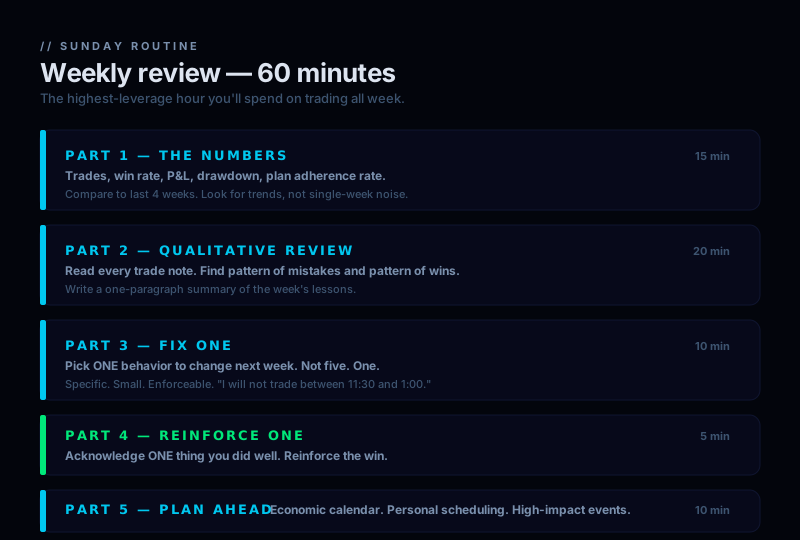
Sixty minutes on a Sunday. The highest-leverage hour you'll spend on trading all week.
Every Sunday, spend 60 minutes on this. Not 30. Not 90. Sixty.
It's the highest-leverage hour you'll spend on trading all week. More than reading market analysis. More than watching YouTube. More than backtesting.
Here's what the hour looks like, broken down:
Part 1 — The numbers (15 minutes)
Pull your journal data for the week. Calculate:
- Total trades taken
- Win rate (% of trades that hit any TP)
- Average win in $ and average loss in $
- Largest winner and largest loser
- Total P&L for the week (in $ and as % of starting account)
- Max drawdown intra-week (largest equity dip)
- Plan adherence rate (% of trades where "Did I follow my plan?" = Y)
Compare these to the previous 4 weeks. You're looking for trends, not single-week noise. One bad week is normal. Three bad weeks in a row is signal.
Specific things to flag: - Win rate dropping below 50% for 2+ consecutive weeks. Something has changed — market regime, your execution, or both. Investigate. - Average loss creeping above 1x average win. You're letting losers run or moving stops. Audit. - Plan adherence below 80%. The strategy is fine. You're the problem. Fix the discipline issue before changing anything else. - Max drawdown larger than 5% of account in a single week. Your sizing is too aggressive for your variance.
Part 2 — The qualitative review (20 minutes)
Open every trade you logged with notes from the week. Read each one. Look for:
Pattern of mistakes. Are losing trades clustered around a specific time of day? Specific instrument? After a specific external event (poor sleep, work stress)?
Pattern of wins. What conditions are present in your best trades? Volatility level? Time of day? Bias confirmation? Cross-asset alignment?
The "almost" trades. Trades you almost took but didn't. Trades you took but almost skipped. These reveal your judgment in real time. Are you skipping winners? Taking losers your gut warned you about?
Write up a one-paragraph summary of the week's lessons. Save it. Six months of these summaries form a real document of your evolution.
Part 3 — The fix-one rule (10 minutes)
Pick ONE behavior to change next week. Just one. Specific, small, enforceable.
Examples: - "I will not trade between 11:30 AM and 1:00 PM. Always lose during chop." - "I will not take a trade without checking BTC and NQ first. Always cross-asset confirm." - "I will close the chart after every TP1 hit and not re-engage for 15 minutes. Reduces overtrading."
ONE thing. The next week, it becomes habit. The week after, you pick the next one. After 6 months you've fixed 26 specific behaviors. That's transformation.
The trader who tries to fix five things at once fixes none of them. Pick one.
Part 4 — The reinforcement (5 minutes)
Pick ONE thing you did well. Acknowledge it. Reinforce it.
"I cut size after the second loss on Wednesday and saved myself from a tilt day."
"I sized up correctly when the briefing bias aligned with multiple signals on Thursday and made my best day of the month."
"I followed my plan even though three signals fired and the FOMO was real."
Trading is hard, lonely work. Most days you're alone with your screen. Acknowledge wins as part of your process. The best traders I know do this religiously.
Part 5 — The plan for next week (10 minutes)
Look ahead. What's on the economic calendar next week? FOMC? CPI? Earnings? Notable events?
For each high-impact event: - Time of release - What you'll do (skip the window? size down? watch only?)
Set the framework now, while you're calm. Sunday-you makes better decisions than Wednesday-during-the-event-you.
Also note any personal scheduling: travel days, important meetings, family commitments. Will you be at full focus all week, or are some days "lighter trading" days? Plan around your life, not despite it.
When to scale up — the rules
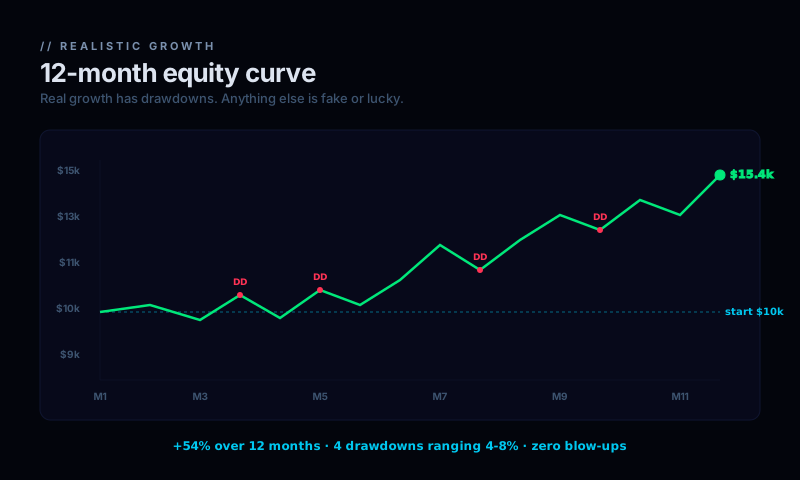
Real growth has drawdowns. +54% over 12 months, 4 drawdowns of 4-8%, zero blow-ups.
After consistent profitability, the question becomes: when do I trade bigger?
Three rules I follow personally and recommend:
Rule 1 — Scale by adding contracts at the same %, not by raising the %.
This was in Lesson 5 but it's worth repeating because it's THE rule of scaling.
If you've been risking 2% on a $10k account = $200/trade = ~1 ES contract worth of risk, and your account grows to $20k, you don't suddenly risk 3%. You keep risking 2% = $400/trade = 2 contracts. Same psychology, larger absolute size.
Rule 2 — Wait for 3 consecutive profitable months before scaling at all.
Don't scale on a single hot week or a single hot month. The math: variance is high enough that any one period can be lucky. Three consecutive profitable months proves the edge is real, not noise.
Rule 3 — When account doubles, scale gradually, not all at once.
Account went from $10k to $20k? Don't immediately double position size. Scale up over 2-3 weeks. Trade 1 contract for the first week at the new account size, then 1.5 the next week (or alternate 1 and 2), then full 2 contracts. The mental adjustment from $200 risk per trade to $400 risk per trade is real, even if the math says it's the same percentage.
When NOT to scale up
Three situations where you should NOT increase size, even if the math says you can:
1. After a hot streak. Three winners in a row makes traders feel invincible. The temptation to "press" is huge. Resist. The hot streak doesn't mean your edge improved — it means variance was kind. Same size.
2. After "feeling more confident." Confidence is not data. The data is your win rate and R/R ratios. If those haven't materially improved, your size shouldn't either, no matter how confident you feel.
3. When personal life is unstable. Job change, breakup, moving, family stress. These all reduce focus. Smaller size during life turbulence, not larger. Trading is the wrong place to "make up" for other life problems.
Funded accounts — the real path to scale
Once you're consistently profitable on personal capital, funded account programs are the practical way to scale beyond what you can fund yourself.
How they work: companies like Topstep, Apex, Tradovate Funded, Take Profit Trader give you trading capital ($25k to $300k+) to trade with. You pass an evaluation phase where you prove consistency, then they fund a real account. You split profits — typically 80-90% to you.
Pros:
- Massive leverage on your skill. Profitable trader on $5k personal = profitable trader on $150k funded.
- Drawdown is theirs, not yours. You lose access to the account but you don't lose your savings.
- Multiple accounts allowed at most firms — you can scale to $500k+ in funded capital.
Cons:
- Evaluation rules are strict. Specific drawdown limits, daily loss limits, profit targets.
- Most evaluation accounts cost $100-300/mo until you pass.
- Many traders can pass the eval but can't run a funded account profitably because the rules feel different from personal money.
My honest take: funded accounts are great IF you've already proven consistency on personal capital. They are NOT the path for beginners. If you can't make money on a $5k personal account, you can't make money on a $150k funded one — you'll just blow up faster with the strict rules.
Plan: get profitable on $2-5k personal for 6+ months. Then start the funded process. Run them in parallel as your personal account keeps growing.
The long view — what this looks like over years
Let me close with the realistic picture. Most courses won't tell you this. I will.
Year 1: You're learning. You'll lose money or barely break even. Focus on execution, journaling, and building habits. This year is tuition.
Year 2: You'll start to see consistency. Maybe a profitable quarter, then a flat one, then another profitable one. The wins are smaller than you hoped. You'll question whether to continue. Continue.
Year 3: Most consistent year. The systems are second nature. Drawdowns don't shake you. You start to see real growth — not 10x in a month like Twitter promises, but 30-50% annual returns with manageable drawdowns. Real returns, real compounding.
Year 4-5: Now scaling matters. Funded accounts, larger personal capital, maybe managing money for others (with proper licensing). The skills compound.
Year 5+: Career. Not a side hustle. Not a "passive income stream" (trading is the opposite of passive). A real, demanding, rewarding career.
This timeline is realistic for serious traders who treat this like a profession. Not weekend hobbyists. Most people quit in year one because the timeline doesn't match the social media promise. Don't be most people.
What I want you to do this week
- Schedule your first full 60-minute weekly review for this Sunday. Block it in your calendar, recurring.
- Apply the scaling rules to your current account. Are you sized correctly for your account size?
- If you've been trading 6+ months consistently, research one funded account program (Topstep, Apex, Take Profit Trader) and evaluate whether it fits.
- Re-read the lessons that hit hardest the first time. The Beginner ones especially. They'll mean different things now.
Lesson 12 takeaways
- 60 minutes every Sunday. Numbers, qualitative review, fix-one, reinforce-one, plan-ahead.
- Scale by adding contracts at the same %, not by raising the %.
- Wait 3 consistent months before any size increase.
- Don't scale during hot streaks, confidence spikes, or life turbulence.
- Funded accounts are the practical scaling path AFTER personal-account consistency.
- The honest timeline is years, not months. Treat it like a profession.
Trade smart. Trade small. Compound. — GP Trading Club