Why this lesson matters
By now you know how to trade each instrument individually. The next level is understanding how they move together — and when they don't.
This is where intermediate traders plateau and advanced traders break through. Once you can read the relationship between ES, NQ, and crypto in real time, you can: - Confirm setups with cross-instrument signals - Avoid false breakouts that one chart alone would suggest - Spot regime shifts before they're obvious - Avoid taking correlated positions that quietly multiply your risk
This isn't required to make money on GP signals. But it's what separates traders who scale from traders who don't.
The basic correlations you need to know
Let's start with the four relationships that matter most:
ES ↔ NQ: Highly correlated. Most days they move together. NQ is typically more volatile (tech-heavy, growth-sensitive). When NQ is leading down hard while ES holds up, that's a warning sign that ES is about to follow. When NQ rips while ES drags, similar story in reverse.
ES ↔ BTC: Moderately correlated, increasing over the last few years. BTC has become a "risk-on" asset — it tends to rally when ES rallies and dump when ES dumps. NOT a perfect correlation, but ignore it at your peril.
BTC ↔ ETH/SOL/XRP: Very high correlation. When BTC dumps 5%, alts dump 7-10%. When BTC pumps, alts amplify. ETH/SOL/XRP rarely move independently of BTC for long.
VIX ↔ everything: When VIX spikes, equities sell off and crypto often follows. Watching VIX as a "fear indicator" gives you early warning on regime shifts.
The leader-follower dynamic
In most market environments, one instrument leads and the others follow. Identifying the leader gives you predictive edge.
During US session (9:30 AM - 4:00 PM ET): ES typically leads the broader risk environment. NQ follows or amplifies. BTC drifts in line with ES sentiment. If ES breaks a key level, watch for crypto to follow within 15-30 minutes.
During Asia/Europe session: BTC often leads. The futures market is closed or thin. Crypto moves on its own catalysts (Asia retail, ETF flows, exchange news). When NY opens, ES will sometimes "catch up" to overnight crypto movement.
During news events: The instrument closest to the news leads. CPI? ES leads. Fed speech? ES and bonds lead. ETF approval? BTC leads. Read the news, identify the closest instrument, watch it first.
How to use correlation in your trading
Three concrete ways correlation helps you, in order of usefulness:
Use #1 — Confirmation
You get a long signal on ES. Before entering, glance at NQ and BTC. Are they also trending up? If yes — that's confirmation. The setup has cross-asset support. Take with confidence.
If ES is signaling long but NQ is dumping and BTC is selling off, that's a divergence. The signal might still work, but you're fighting the broader risk-off flow. Take smaller, exit faster, or skip.
Use #2 — Avoiding double-dipping risk
You have a long position on ES. A long signal fires on NQ. Should you take it?
Mostly no. Here's why: ES and NQ are 0.85+ correlated most days. If you go long both, you're essentially doubling your exposure to "US equities going up." If they reverse together (which they usually do), you take double the loss.
Rule: if you already have an active position on a correlated instrument, scale down or skip the second signal. Otherwise you're risking 4% of account, not 2%, even though it looks like two separate trades on paper.
The same applies to BTC and ETH/SOL/XRP. A long on BTC plus a long on ETH = double crypto risk, not diversification.
Use #3 — Spotting regime shifts
When normally-correlated assets decouple, something is shifting. Examples:
- BTC pumps 5% while ES dumps 1%. Probably a crypto-specific catalyst (ETF news, exchange flow, etc.). The "risk-on/risk-off" model isn't applying right now.
- NQ outperforms ES by a wide margin. Tech is leading — could be earnings season, rate expectations shifting, AI narrative back in play.
- VIX spikes but ES holds up. Markets are pricing in upcoming volatility but not yet selling. Often a setup for a 1-2 day pullback.
Recognizing decoupling helps you not blindly assume "if ES is up, BTC must be up." That assumption fails badly during regime shifts.
A simple correlation dashboard
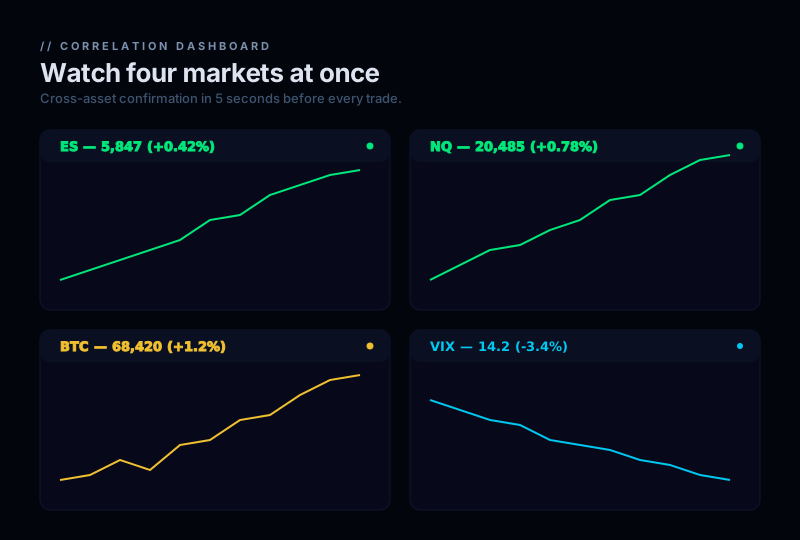
Watch four markets at once. Cross-asset confirmation in 5 seconds before every trade.
You don't need fancy software. Here's a basic setup I recommend:
On TradingView, open a 4-chart layout: - ES (15-min) - NQ (15-min) - BTC (15-min) - DXY or VIX (15-min)
Sync the time scrollbars so they all show the same window. Glance at this layout before every trade. 5 seconds. Confirms or denies the setup.
For Advanced students who want to get fancier: - Add a "ratio chart" of NQ/ES on TradingView (NQ1!/ES1!). Shows tech leadership in real time. - Add a "BTC vs SPX" overlay if you want to track decoupling visually.
Hedging — the basics
Once you understand correlation, you can hedge. Hedging means taking an offsetting position to reduce risk.
Two scenarios where hedging makes sense:
Scenario A — Holding a swing position overnight.
You have a long ES position you want to hold for a couple days. Tomorrow morning is a CPI release. You're worried about the gap risk.
Hedge: short a smaller NQ position. If both crash on CPI, your NQ short profits offset your ES loss. Total damage is reduced. Of course, if both rip up, your NQ short loses while ES wins — net P&L is muted but not negative.
Scenario B — Heavy crypto exposure ahead of US session.
You have BTC long positions and ES is showing weakness pre-market. Risk: ES dumps, drags BTC down with it.
Hedge: small ES short. Reduces correlated downside.
Honest take on hedging: for most retail traders, hedging is overkill. The simpler move is just sizing down or closing positions before high-risk events. Hedging adds complexity and execution risk. Save it for when you're managing a larger account where partial protection makes sense.
Pair trading — advanced concept
Pair trading is taking two correlated instruments and trading the spread between them. Example: long NQ / short ES when you think tech will outperform.
The trade isn't direction. It's relative strength.
Pros: market-neutral. You don't care if the whole market goes up or down. You only care that NQ outperforms ES.
Cons: requires understanding of how much to size each leg. ES tick value is $12.50, NQ is $5 — you need different contract counts to balance risk.
Honest take: pair trading is fascinating but rarely worth it for retail. The execution complexity and capital required usually outweigh the benefit. Mention here so you know it exists. Skip unless you're trading a larger account and have a specific edge you've backtested.
When correlation breaks (and what to do)
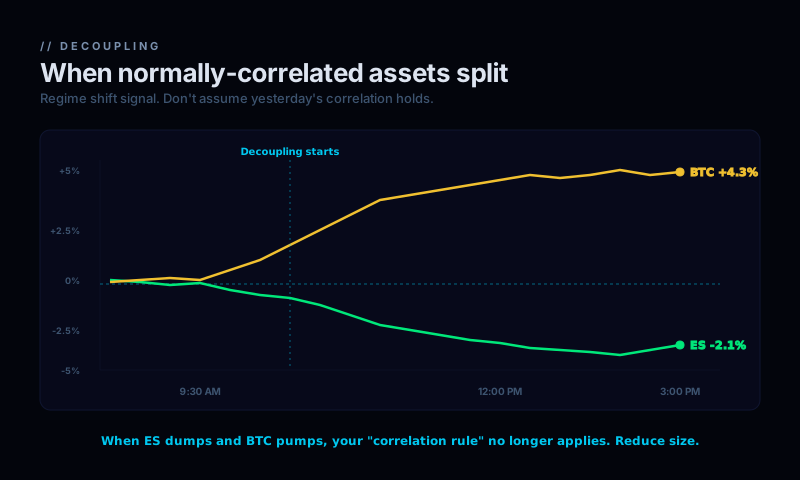
When ES dumps and BTC pumps, your 'correlation rule' no longer applies. Reduce size.
Markets occasionally enter "everything correlated" regimes. Most famous: the 2020 COVID crash. ES dumped, BTC dumped, gold dumped, even Treasuries briefly dumped. Everything sold off as people raised cash.
Lesson: in extreme stress, correlations go to 1. Diversification across instruments doesn't protect you. Only being out (or short) does.
When you sense a regime like this approaching: - Reduce overall position size, regardless of instrument. - Skip lower-conviction signals. - Don't assume your "uncorrelated" trades are uncorrelated when fear takes over.
What I want you to do this week
- Set up a 4-chart layout: ES, NQ, BTC, VIX. Watch them together for a week. Notice the leader-follower patterns.
- On every GP signal, do a 5-second cross-asset check before entering. Note in your journal whether confirmation aligned.
- Track if you ever ended up with two correlated positions open at once. If yes, reflect on whether you doubled your effective risk.
- Read Lesson 11 next: Taking a GP Signal in Live Action — Walkthrough.
Lesson 10 takeaways
- ES and NQ are highly correlated. ES and BTC are moderately correlated. Watch all three.
- Use correlation for confirmation, not for taking double-dipped trades.
- Decoupling reveals regime shifts before they're obvious.
- Hedging is real but rarely worth it for small retail accounts.
- In stress regimes, all correlations go to 1. Reduce size, don't assume diversification protects you.
See you in Lesson 11. — GP Trading Club