Why this lesson matters
By now you know how to read signals, manage risk, set stops, and journal your trades. You have all the technical tools. And yet — if you're like 95% of traders — you still occasionally do dumb things you can't explain afterward.
Welcome to the real boss fight: your own brain.
After years in this market, I can tell you with certainty: the gap between profitable and unprofitable traders is rarely strategy. It's psychology. Two traders can have the same signal, the same broker, the same risk rules — and one makes money while the other doesn't. The difference happens in the 3 seconds between "I should take this" and "I'm clicking the button."
This lesson is about the two enemies that have killed more accounts than any market crash: FOMO and revenge trading. Recognize them, name them, defeat them.
FOMO — Fear Of Missing Out
The pattern: you see a candle ripping up. You weren't in the trade. Your brain says "it's still going, I can catch the rest." You enter. Price reverses 30 seconds later. You're now in a bad trade with no edge, no plan, and a stop that's too wide because you were thinking about profit instead of risk.
This is FOMO. It is biological, not rational.
Here's what's actually happening in your brain: - You see a fast move and your nervous system reads it as "missed opportunity." - Cortisol and adrenaline spike. You feel urgency. - Urgency narrows your focus. You only see the upside, not the risk. - You click. The trade has no edge because you didn't enter on a setup — you entered on a feeling. - The market reverses (because by the time YOU saw it, the easy money was already taken). You're in a loss.
FOMO trades have no edge by definition. You didn't enter from a system, you entered from a feeling. Feelings don't have edge. Systems do.
How to defeat FOMO
Five tools that work, in order of effectiveness:
1. Pre-commit out loud. Before the trading day, say it: "I only take GP signals. I don't chase candles." Hearing yourself say it activates a different part of the brain than just thinking it. It sticks.
2. Stick to your watch list. GP signals are explicit setups. Anything outside that is a distraction. When you see a candle ripping that's NOT a GP signal, your default is "watch, don't trade." Train this.
3. Set a "minimum prep" rule. Before any trade, complete a 15-second checklist: Is this a GP signal? Is the bias aligned? Is my size set correctly? Is my stop placed? If you can't complete the checklist, the trade isn't valid. FOMO trades fail this checklist every time.
4. Reduce screen time. The more candles you watch, the more chances FOMO has to ambush you. Watch less. Stick to your trading windows. Walk away when you're not actively trading.
5. Track FOMO trades in your journal. Mark them clearly: "FOMO entry, not a system trade." Review them weekly. The data will show you exactly how badly they perform compared to system trades. Once you see it in numbers, the temptation drops.
Revenge trading — the account killer
Revenge trading is FOMO's bigger, meaner cousin. The pattern:
You take a loss. The market just took $200 from you. Your brain wants it back. NOW. You see the next setup — or sometimes you don't even wait for one — and you take a bigger size to "make it back faster." This trade also loses. Now you're down $500 instead of $200. The cycle accelerates.
By the end of a revenge spiral, traders routinely lose 5-10x what they would have lost on the original trade. This is how single-day account blow-ups happen.
I've seen this destroy accounts that took years to build. In 90 minutes. Don't let it be yours.
The neurology of revenge trading
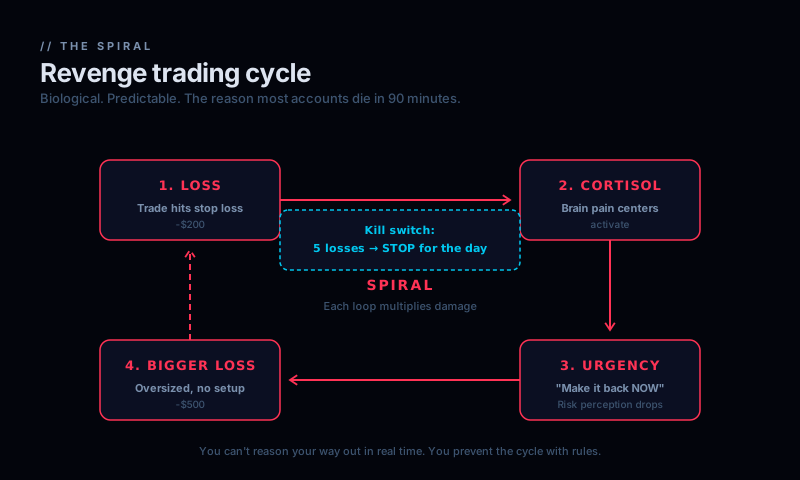
Biological. Predictable. The reason most accounts die in 90 minutes after the first loss.
Same as FOMO, this is biological. After a loss: - The brain's pain centers light up. A losing trade hits you the same way physical pain does. - The same neural circuits that drive aggression in social conflicts now drive your trading decisions. You don't want to make money — you want to "win back" what was taken. - Risk perception drops. Size feels less scary. Setups look more obvious. You're in a fog. - The trades you take in this state have negative expected value, even if the strategy is sound — because YOU are not sound.
You cannot reason your way out of this state in real time. You have to prevent the state from controlling your trading.
The 5-loss kill switch
The single most important rule I follow personally and recommend to every trader:
After 3 consecutive losses → cut size to 1%
After 5 consecutive losses → STOP TRADING for the day. Period.
Three losses is normal variance. Five is a signal something is off — and even if it's just bad luck, your psychology is now compromised whether you feel it or not. Walking away after 5 losses is not weakness. It's the most professional thing you can do.
I've never regretted walking away after 5 losses. I have, in earlier years, regretted not walking away — every time.
Set this as a hard rule. Some traders even put it in their broker as a max-daily-loss limit so the platform enforces it. If your broker offers this, use it.
The recovery protocol
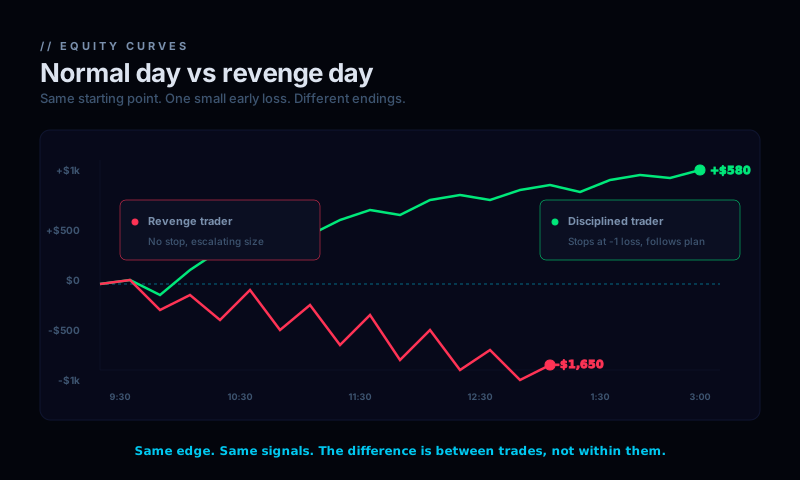
Same edge, same signals. The difference is what happens BETWEEN trades, not within them.
If you blow past the kill switch and find yourself in a revenge spiral, here's the recovery protocol I use:
Step 1 — Close all positions immediately. Don't try to "save" any of them. Cut everything to flat. The longer you stay in trades while compromised, the deeper the hole.
Step 2 — Walk away from the screen for 60 minutes. Physically leave the chair. Go outside. Eat something. Talk to a human. The cortisol takes 45-60 minutes to clear from your system. There is no shortcut.
Step 3 — Don't re-engage for the rest of the day. The day is done. Whatever you "miss" by not trading, you'll save 10x by not trading worse.
Step 4 — Journal the spiral the next morning. Not that night. Sleep first. Then write everything: what triggered it, what you felt, where you were when each bad decision happened. This is data for next time.
Step 5 — Take an entire day off if it was bad. The day after a major spiral, your brain is still in chemical recovery. Trading the next morning often leads to round two. Take Tuesday off. Come back Wednesday clean.
Tilting on a winning streak — the silent killer
Most traders think tilt only comes from losses. Wrong. Some of the worst account damage I've seen came after wins.
Pattern: trader has 5 winners in a row. Feels invincible. Sizes up. Takes lower-quality setups because "I'm hot right now." First loss is taken with oversized position. Then revenge starts on a smaller emotional base, but bigger dollar amount.
Net result: the winning streak that should have grown the account ended up shrinking it.
Defense: keep risk percentage flat regardless of recent results. Don't size up after wins. Don't size down after losses (until the kill switch triggers). The system is the system. Your emotions don't get to vote.
Identifying YOUR specific tilt triggers
Everyone has different triggers. Learning yours is one of the highest-leverage things you can do as a trader. Common triggers I've seen:
- Time pressure — having 30 min before a meeting and trying to "get a quick trade in"
- External life stress — argument that morning, money worries, sleep loss
- Specific instruments — some traders only tilt on NQ, never ES
- Specific times of day — the 11 AM-1 PM chop window destroys discipline for many
- Caffeine + boredom — too much energy, no setups, leads to forced trades
- Watching too long without trading — eventually you'll find a "trade" just to feel productive
Your job: identify which of these (or others) are YOURS. The journal helps. After 30 trades, you'll see the patterns.
Once identified, you build rules around them. "I don't trade in the 30 minutes before a meeting." "I don't trade when I've slept less than 6 hours." "I don't trade NQ before 10:00 AM." Specific. Enforceable. Non-negotiable.
The mindset that wins long-term
After all the years and all the trades, here's the mental model that I've found makes the biggest difference:
Each trade is just one of thousands.
Your career as a trader will involve thousands of trades. This particular one — the one that just lost, or the one you "missed" — doesn't matter on its own. It matters only as a data point in a long career.
The trader who internalizes this stops emotionally reacting to individual outcomes. He follows the system. The system has positive expected value over thousands of trades. Variance happens trade by trade, but the math works out over the long run.
The trader who doesn't internalize this lives and dies on every single trade. Every win is euphoria. Every loss is a wound. He burns out in 18 months.
Be the first kind of trader.
What I want you to do this week
- Identify your top 3 tilt triggers from your journal data. Write them down.
- Build a kill-switch rule for yourself: number of consecutive losses that triggers a stop-trading day. Implement it in your broker if possible.
- Practice the "watch, don't trade" response when you see non-system setups ripping. Note in your journal every time you successfully resist a FOMO entry.
- Read Lesson 10 next: Multi-Asset Correlation — ES/NQ vs Crypto.
Lesson 09 takeaways
- FOMO and revenge trading are biological, not rational. Defeat them with rules, not willpower.
- Pre-commit out loud. Pre-prepare your watch list. Pre-decide your kill switch.
- Walk away after 5 consecutive losses. Always. No exceptions.
- Tilting on wins is real. Don't size up after a streak.
- Each trade is one of thousands. The system wins over time, not over single trades.
See you in Lesson 10. — GP Trading Club