Why this lesson matters
You can have great signals, perfect risk management, and a solid pre-market routine. And still plateau. Still make the same mistakes. Still wonder why you're not improving.
The missing piece for 90% of traders is journaling. Not the half-hearted "I won this trade, I lost that one" kind. Real journaling — the kind that makes invisible patterns visible.
After almost a decade in this market, I can tell you: the traders who journal seriously improve. The traders who don't, plateau or regress. There's no third path.
What a journal actually is
A trading journal is not a diary. It's not for emotional venting (although that has its place — see Lesson 9). It's a dataset of your own decisions that you build over time, then mine for patterns.
The point: you cannot fix what you cannot see. Your brain hides your worst patterns from you. Journaling forces them into the light.
What to record on every trade
For every trade you take, log these:
Pre-trade:
- Date and time of entry
- Instrument (ES, NQ, BTC, etc.)
- Direction (long/short)
- Entry price
- Stop loss price
- Target price (TP1 and TP2)
- Position size (contracts)
- Risk in dollars (should be ~2% of account)
- Signal source (GP signal score, or self-generated setup)
- Briefing alignment (does this trade match today's bias? Y/N)
Post-trade:
- Exit price
- Exit reason (TP1, TP2, SL, manual)
- Actual P&L in dollars and as % of account
- Did I follow my plan? (Y/N — be honest)
- One-line note on the trade
End of day:
- Total trades taken
- Win rate today
- Cumulative P&L
- One sentence: what did I learn today?
This sounds like a lot. It takes 90 seconds per trade once you have a template. It's worth it.
The format that works
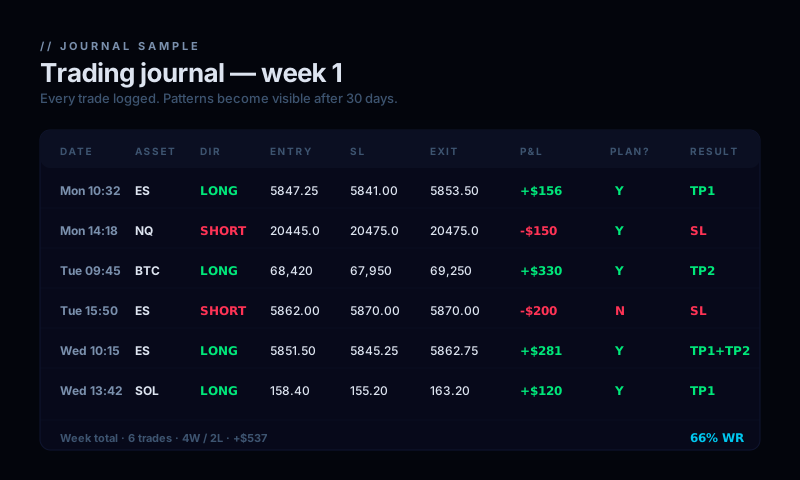
Six trades. Four wins, two losses. 66% win rate. The data starts to talk after 30+ trades.
Three options for keeping your journal:
Option 1 — Spreadsheet (recommended for beginners). Google Sheets or Excel. Columns for each field above. Rows for each trade. Pivot tables and charts at the end of every month.
Pros: simple, free, your data is yours. You can run filters and find patterns ("show me all my losing trades on NQ before 9:30 AM" — bam, three clicks).
Cons: manual entry. After a hundred trades you'll wish you had automation.
Option 2 — Dedicated journaling apps. Edgewonk, Tradervue, TraderSync. They auto-import trades from your broker. Built-in analytics. Worth $25-50/mo if you trade actively.
Pros: less manual work, better visualizations. Cons: cost, vendor lock-in.
Option 3 — Notebook + spreadsheet hybrid. The data goes in a spreadsheet. The "what did I feel, what did I learn" goes in a physical notebook.
This is what I do. The hand-writing of the qualitative part forces engagement that typing doesn't. The data part stays in spreadsheet for analysis.
Pick whichever you'll actually use. The "best" journal is the one you keep up with.
What to look for after 30 days
Once you have 30+ trades logged, the patterns start showing. Here's what I look for in my own data, and what I want you to look for in yours.
Pattern 1 — Time-of-day performance. Group your trades by entry hour. What's your win rate at 9:30 AM vs 11:00 AM vs 3:00 PM? Most traders have a "best hour" they don't know about. Once you find yours, you can stop trading the hours you suck at.
Pattern 2 — Instrument-specific edge. Some traders are great at ES, mediocre at NQ, terrible at crypto. Or vice versa. Look at win rate AND average R/R by instrument. The instrument where you're worst — consider trading it less, or sizing smaller, until you understand why.
Pattern 3 — Plan adherence. The "Did I follow my plan? Y/N" column is gold. Calculate your win rate on Y trades vs N trades. The gap is usually huge — like 65% Y vs 35% N. That gap is money you're throwing away by not following your own plan.
Pattern 4 — Setup type. If you take both GP signals and your own setups, separate them. Compare. Are you better with the system or your own ideas? Be honest with the data, even if it bruises your ego.
Pattern 5 — Loss size patterns. Are your losing trades bigger than they should be? If your average loss is 1.3x your average winner, you're moving stops or letting losers run. Cuts directly into profitability. The journal makes this brutally visible.
The weekly review — where the magic happens
Every Sunday, spend 30 minutes reviewing the week.
Step 1 — The numbers. Total trades, win rate, total P&L, average win, average loss, biggest winner, biggest loser. Plain math.
Step 2 — The honesty pass. Open every trade I logged "Did I follow plan? N" on. Read the one-line note. Ask: what was I feeling? Tired? Bored? Revenge-trading from yesterday? Pattern emerges over weeks.
Step 3 — One thing to fix. Pick ONE behavior to change next week. Not five. One. "I will not trade between 11:30 and 1:00 — I always lose then." Or "I will not take trades that don't match the briefing bias." Specific, small, enforceable.
Step 4 — One thing that worked. Pick ONE thing you did well. Reinforce it. "I cut size after the second loss on Tuesday and saved myself a tilt day." Pat yourself on the back. Trading is hard. Recognize wins.
This 30 minutes per week, over 6 months, is more transformative than any course you'll buy.
What journaling reveals (real patterns I've seen)
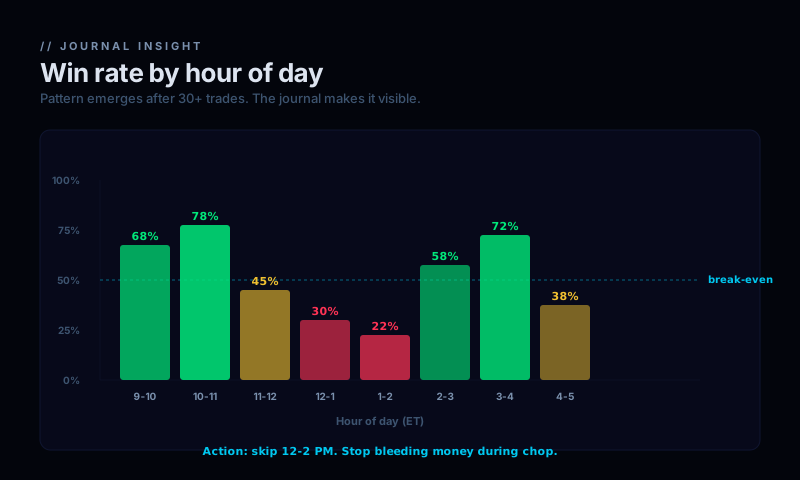
After 30 days, this is the kind of pattern only the journal reveals.
Here are patterns I've seen in my own data and in students' journals over the years. See if any of these are you:
- The 4 PM giveback. Trader does great until 3:30, then revenge-trades the chop and gives back half the day's profit.
- The Monday tilt. Loses on Monday morning more than any other slot. Turns out he's still mentally checked-out from the weekend.
- The size creep. When winning, size grows from 1 contract to 2 to 3 over the day. When losing, size shrinks. Net result: small wins, big losses. Profitable system, unprofitable trader.
- The signal cherry-pick. Takes 60% of GP signals. Win rate on the ones taken: 55%. Win rate on the ones skipped: 65%. He's filtering out winners with his own bias.
You don't see these patterns because they're invisible to you in the moment. The journal is the only way they become visible.
What to do when you're losing
This is when journaling matters most. Three rules:
- Keep journaling, even when you don't want to. The trades you most want to forget are the ones with the most data.
- Don't change strategy first. Change behavior first. Most "strategy isn't working" is actually "I'm not following the strategy." The journal proves which one is true.
- Every loss has a "why" beyond the market. Maybe the entry was off. Maybe the size was wrong. Maybe you took it without bias confirmation. Find the why. Write it down. Avoid the same trap next week.
What I want you to do this week
- Set up your journal. Spreadsheet, app, or notebook — pick one and start.
- Log every trade for the next 7 days. Even the bad ones. Especially the bad ones.
- On Sunday, do your first weekly review. 30 minutes. Find one thing to fix next week.
- Read Lesson 9 next (Advanced Module): Psychology Advanced — FOMO and Revenge Trading.
Lesson 08 takeaways
- Journaling makes invisible patterns visible. Your brain hides the worst ones from you.
- Log every trade. Pre-trade plan + post-trade outcome + one-line lesson.
- Weekly review is non-negotiable. 30 minutes Sunday. Fix one thing. Reinforce one thing.
- The "Did I follow my plan?" column is the most valuable data you'll ever have.
- Keep journaling when losing. That's when it pays the most.
See you in Lesson 9. — GP Trading Club