Why this lesson matters
The traders who consistently make money don't show up at 9:30 AM and start clicking buttons. They show up at 8:15 already knowing what they're going to do. The market opens, the chaos starts, and they're calm because they prepared.
The 30-45 minutes between 8:00 and 9:30 AM ET is the most undervalued window in retail trading. This is where edge is built. This lesson is about how to use it.
The cost of trading unprepared
Walk in cold and what happens? You react instead of acting. You see a candle move and chase. You see green and assume strength. You see red and assume weakness. You're guessing.
Now compare that to a trader who walked in with a plan: - "Today's bias is bullish above 5,840 on ES, bearish below." - "Key resistance: 5,855. Key support: 5,830." - "If I see a long signal between 5,840 and 5,855, I take it. Above 5,855, I wait for confirmation."
When the signal hits, the prepared trader executes. The unprepared trader hesitates, doubts, second-guesses. Hesitation costs trades. Trades cost money. Preparation is free. Skipping it is expensive.
The GP Daily Briefing — your prep, done for you
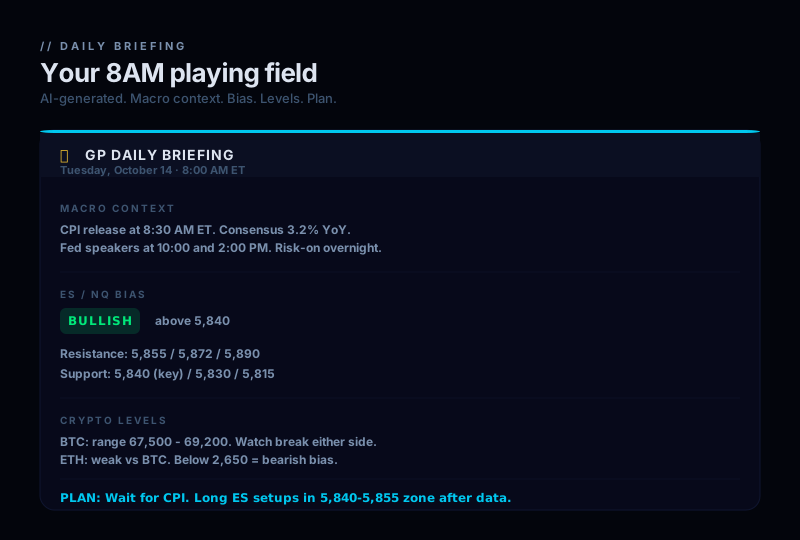
AI-generated. 8:00 AM ET. Macro context, bias, levels, plan — all in 60 seconds of reading.
Every weekday at 8:00 AM ET, the GP Daily Briefing drops. AI-generated, but built on the same framework I use myself: macro context, ES/NQ bias, crypto levels, key zones to watch.
It's not magic. It won't tell you exactly what trade to take. What it does: it gives you the day's playing field so you don't have to assemble it from scratch every morning.
Here's how to extract maximum value from it.
How to read the Daily Briefing in 5 minutes
A typical briefing has four parts:
1. Macro context What's happening in the broader world that the market cares about today. Fed speeches, economic data releases, geopolitical events, earnings drops.
What you do with this: identify "danger windows" — times when news could move price violently. Common ones: - 8:30 AM ET: economic data (CPI, jobs, GDP) - 10:00 AM ET: secondary data - 2:00 PM ET: FOMC announcements (only on FOMC days)
If a danger window is in the next hour, don't take a trade in the 30 minutes before or after. The market gets manipulated, stops get hunted, and signals fire weirdly. Protect your capital by sitting out these windows.
2. ES/NQ bias The briefing gives you a directional lean for futures: bullish, bearish, or neutral. Plus the levels that confirm or invalidate that lean.
What you do with this: filter signals. If the briefing says "bullish bias above 5,840," I'm more aggressive on long signals and more conservative on shorts. If a short signal fires when bias is bullish, I take it smaller, or skip entirely.
3. Crypto levels Same idea, but for BTC/ETH/SOL/XRP. Where's the key support, where's the resistance, what's the regime (trending vs ranging).
4. Trading plan The briefing usually closes with a one-paragraph plan: "Watch for X, avoid Y, key trade idea is Z." This is your default mode for the day. Adjust based on what actually happens.
My personal pre-market routine
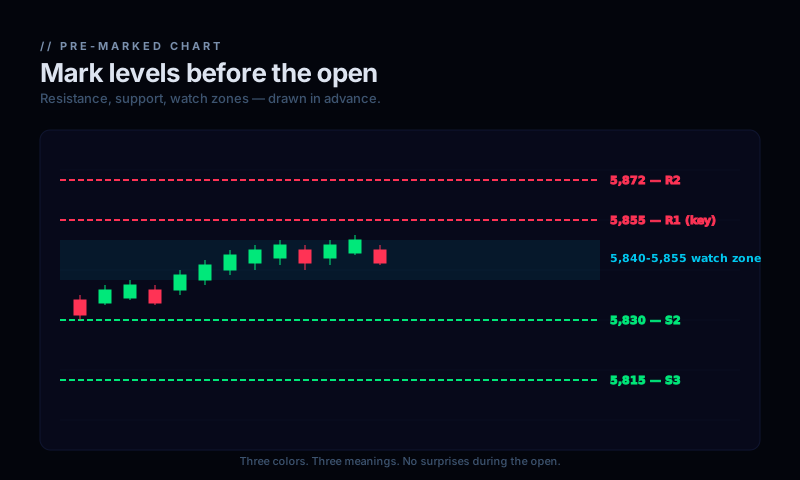
Three colors. Three meanings. No surprises during the open.
Here's what I actually do every morning. Adapt it to your schedule.
7:45 AM — Coffee, no screens. Get my head clear. Look at sleep score, energy, mood. If I'm not in shape to trade today, I decide now, before adrenaline kicks in. This is rare but it happens.
8:00 AM — GP Daily Briefing. Read it twice. Once fast for the gist, once slow for the details. Note levels on a paper notepad — analog. Forces me to actually engage with them.
8:10 AM — Check overnight action. Where did ES close yesterday? Where did Asia and Europe trade overnight? Big gap up, big gap down, or flat? This colors the briefing.
8:20 AM — Mark my charts. Open TradingView. Mark the key levels from the briefing as horizontal lines. Color code: green for support, red for resistance, yellow for "watch zone."
8:30 AM — Economic calendar check. Anything big at 8:30, 10:00, or 2:00? If yes, plan around it.
8:45 AM — Review my plan out loud. "Today I'm bullish above 5,840. I take long signals at 5,840-5,855 with normal size. Above 5,855, I wait for confirmation. Below 5,830, I look for shorts. I'm sitting out 8:25-8:45 if the data drops."
This 5-minute exercise catches half my mistakes before they happen.
9:30 AM — Market open. I'm calm because I'm prepared. The chaos doesn't faze me. I follow my plan. If a signal aligns with the plan, I take it. If it doesn't, I skip it.
That's the whole routine. 45 minutes. It's the highest ROI 45 minutes I spend all day.
Common pre-market mistakes
Mistake 1: Skipping the briefing on slow days. "It's just a chop day, I don't need to prep." Then a surprise news drop happens at 9:45 and you're caught with no plan. The day you skip prep is the day the market punishes you for it.
Mistake 2: Reading the briefing once and forgetting it. Read it twice. Mark your charts. Reference it during the day when a signal fires. Otherwise the briefing is theater, not preparation.
Mistake 3: Overriding the bias because of "what you see." Briefing says bullish bias. You see one red candle and decide it's actually bearish today. Your gut just overrode the framework. Trust the structure unless the bias-invalidation level breaks. That level is in the briefing for a reason.
Mistake 4: Trading the same plan for ES and crypto. ES and crypto have different rhythms. The briefing handles each separately. Don't apply ES bias to your BTC trades.
When to deviate from the briefing
Almost never, in your first year.
After that, here are the times I personally deviate: - Bias-invalidation level breaks definitively. Bias was bullish, but ES just sliced through 5,840 with volume. Bias is now neutral-to-bearish. I update my plan. - Surprise news drops mid-session that the briefing couldn't have predicted. - Volatility regime shifts (VIX explodes, BTC dumps 5% out of nowhere).
In all three cases, my rule is: don't immediately reverse direction. Step back. Wait 15 minutes. Reassess. The market often false-breaks before resuming. Trading the immediate reaction loses money over time.
The end-of-day routine — closing the loop
Pre-market prep is half the loop. End-of-day review is the other half.
After the close, take 10 minutes to: 1. Did I follow today's plan? Y/N. If no, why? 2. Did the briefing's bias play out? Or did it get invalidated? 3. Mark up my chart with what happened — drawing the key levels, the actual moves, where my trades hit. 4. One sentence in the journal: what did I learn today?
This compounds. Six months of daily 10-minute reviews and you'll have absorbed more than most traders learn in 5 years of unstructured screen time.
What I want you to do this week
- Read every GP Daily Briefing this week, even if you don't trade that day.
- Build a pre-market checklist that fits your schedule. 30 min, 45 min, 60 min — whatever works.
- After each trading day, write 1-2 sentences on whether the briefing's bias played out.
- Read Lesson 8 next: Journaling — The Habit That Separates Pros from Amateurs.
Lesson 07 takeaways
- Show up prepared or get punished. There's no third option.
- The GP Daily Briefing is your daily playing field — read it twice.
- Build a 30-45 min pre-market routine and stick to it.
- Mark levels on charts before the open, not during.
- Don't deviate from the briefing's bias on impulse — wait for the invalidation level.
See you in Lesson 8. — GP Trading Club