Why this lesson matters
Of all the ways traders blow up, one mistake outranks every other: moving the stop loss.
Not bad strategy. Not bad signals. Not bad luck. Moving the stop loss further away when a trade goes against you.
I've seen it kill more accounts than any other single behavior. After years of watching this happen — to myself in my early days, and to traders I've taught — I can tell you with certainty: if you can master your stop loss, you'll outlast 95% of the people in this market.
This lesson is about everything stop-loss-related: the rules, the variations, the psychology, and the one thing you must never, ever do.
The non-negotiable rule
Once you set your stop loss, you may move it CLOSER to entry. Never further away.
That's it. The whole rule.
If price approaches your stop, that's the trade telling you it's wrong. Moving the stop is you telling the trade to shut up. The market doesn't shut up. The market keeps moving. And now your "small" 25-tick loss becomes a 60-tick loss, then 100, then a margin call.
I want you to internalize this so deeply it becomes physical. The hand that hovers over the stop adjustment is the hand that destroys accounts.
Why traders move stops (and why every reason is wrong)
Let's go through the lies your brain tells you in the moment.
"It's about to bounce." Sometimes it does. Sometimes it doesn't. Over hundreds of trades, the math is brutal: trades that violate your stop go on to violate it by a lot, far more often than they bounce back to profit. The 5% of times you "save" the trade is paid for by the 95% of times it goes much deeper. You lose net money by moving stops, even when individual trades occasionally bail you out.
"The market just took out my stop and reversed." Yes, this happens. It's called a stop hunt. It's annoying. It is NOT a reason to widen your stop preemptively. The right response is to use a slightly less obvious stop placement on the next trade, not to remove the stop on this one.
"I have time, I can wait it out." The trade has changed. The original setup is dead. You're now in a different trade — one with worse R/R, more risk, and based on hope instead of edge. Hope is not a strategy.
"I'll move it to the next support level." This is the most sophisticated-sounding lie. Sometimes it even works. But you're now redefining the trade after the fact, which means you don't really have a trading system — you have a bias. Bias loses to systems over time.
Every reason you'll come up with sounds smart in the moment. They're all wrong. Set the stop. Honor it.
Where to actually place the stop
GP signals come with the stop pre-calculated. Trust them.
But for context, here's how I think about stop placement on trades I take outside the system:
Technical stops (recommended): - Below the most recent swing low for longs. - Above the most recent swing high for shorts. - Beyond the recent ATR range so noise doesn't take you out.
Round-number stops (avoid): - Right at 5,800.00 on ES, or $80,000 on BTC. Why? Every retail trader and their dog put stops at round numbers. Algorithms hunt them deliberately. Set your stop a few ticks beyond round numbers, not at them.
Time-based stops (advanced): - "If this trade isn't in profit by 30 minutes, I'm out regardless of price." - Useful for scalpers and high-frequency setups. Not standard for the GP system, but worth knowing.
The key principle: place the stop where the trade thesis is wrong, not where you "can afford" to lose. If you can't afford to put the stop where the thesis breaks, your position is too big. Reduce size, don't compromise the stop.
Trailing stops — the right way to "move" a stop
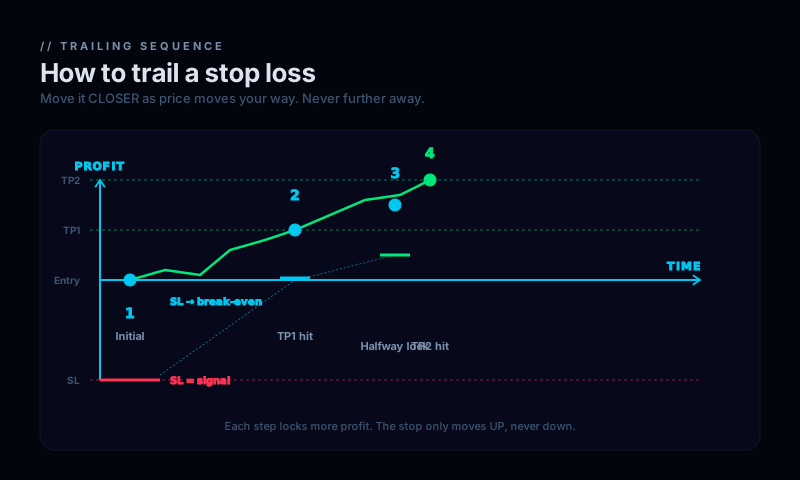
Each stage locks more profit. The stop only moves UP, never down.
Trailing the stop is the ONE legitimate way to move it. The rule:
You can move the stop CLOSER to entry (toward break-even or profit) once price moves in your favor. You can never move it further from entry.
How I personally use trailing on GP signals:
Phase 1 — Initial: Stop placed at the signal's SL level. Don't touch.
Phase 2 — TP1 hit: Move stop to break-even (entry price). Trade is now risk-free. If it reverses, you exit flat. This is one of the most psychologically powerful moves in trading.
Phase 3 — Halfway to TP2: Move stop to lock in 30-50% of the move. You're guaranteeing profit even if the trade reverses.
Phase 4 — Near TP2: Either let TP2 hit, or trail the stop very tight (5-10 ticks behind price) and let it ride further if momentum is strong.
This is a manual process at first. Over time it becomes second nature.
The break-even stop — your best friend
The single most underused tool in retail trading: moving stop to break-even after the trade is going your way.
Why it's powerful: - Psychologically, you can no longer lose on this trade. The fear of giving back profit disappears, which lets you make better decisions on the runner. - Mathematically, you've removed the trade from your loss column entirely. Your equity curve gets smoother. - Behaviorally, knowing you have a break-even stop available makes you actually take the trade in the first place — fewer "should I or shouldn't I" hesitations.
Rule of thumb: move stop to break-even after the trade has moved 60-70% of the way to TP1. Not at TP1 itself (you might get stopped on the wick). Just before.
Stop loss orders — types you should know
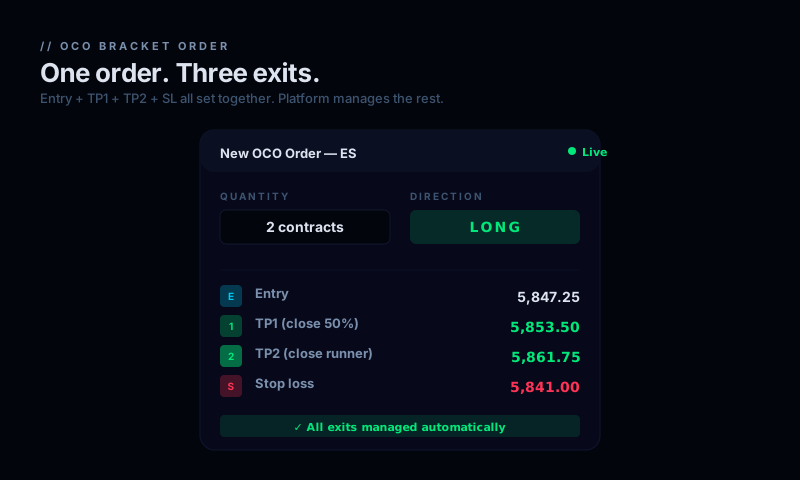
Entry + TP1 + TP2 + SL all set together. The platform manages the rest while you walk away.
When you place a stop in your broker, you have options:
Stop Market: triggers a market order when price hits your level. Pros: guaranteed exit. Cons: in fast markets, slippage can make your fill worse than your stop level. Best for liquid instruments (ES, NQ, BTC).
Stop Limit: triggers a limit order. Pros: you control the exit price. Cons: in a fast move, your limit may not fill at all — and you're now riding the loss with no stop. Dangerous for risk management. I don't recommend stop-limit orders for stop losses unless you really know what you're doing.
OCO (One-Cancels-Other): brackets your trade with both a take-profit AND a stop-loss. When one hits, the other cancels automatically. This is what you should use on every trade. Tradovate, NinjaTrader, and Bybit all support OCO.
My setup: every trade goes in as an OCO bracket with TP1 (partial), TP2 (runner), and a stop market for the SL. I don't have to babysit. The platform manages exits while I do other things.
Stop loss psychology — the part nobody talks about
Here's the dirty truth about stop losses: knowing the rules isn't enough. The hard part is sitting with the discomfort when price approaches your stop.
When you watch a trade go against you, your brain releases real cortisol. You feel it physically. Heart rate up, palms damp, focus narrowing. In that state, you make worse decisions. The trader who moves the stop isn't dumb — he's biologically hijacked.
The defenses:
- Set the stop in the broker, then close the chart. You can't tinker with what you can't see. Some pros literally walk away from the desk after entry.
- Pre-commit out loud. "If price hits 5,841, I'm out. No exceptions." Saying it before you're in the trade reinforces the rule when it matters.
- Track every stop hit. Keep a journal entry: did I follow my stop? Y/N. Visibility kills bad behavior. (Lesson 8 covers journaling in depth.)
- Reward stops as much as wins. A trade that stops out at planned SL is a successful trade, not a failed one. The system worked. The market didn't go your way. That's all.
What I want you to do this week
- On every GP signal, set the stop in the broker as an OCO bracket the moment you enter.
- Practice the trailing sequence: initial SL → break-even at 60-70% to TP1 → lock-in at halfway to TP2.
- Audit your last 10 trades. Did you ever move a stop further away? Be honest. Note what happened.
- Read Lesson 7 next: Pre-Market Routine with the Daily Briefing.
Lesson 06 takeaways
- Never move the stop further away. Ever. This is the rule.
- Trail stops closer (toward profit) as the trade works. This is required, not optional.
- OCO brackets handle exits automatically. Use them on every trade.
- Stop hits aren't failures — they're the system protecting you.
- Manage the psychology with pre-commitment and journaling.
See you in Lesson 7. — GP Trading Club