Why this lesson matters
The 2% rule from Lesson 4 keeps you alive. But once you've been trading for a few months, you'll notice something: a 2% risk on ES feels very different from a 2% risk on BTC. Same dollar risk, completely different experience. Why?
Because volatility isn't constant. A 25-tick stop on ES at 9:30 AM is meaningfully different from a 25-tick stop at 3:00 AM. Same number, different reality.
Once you understand this, you stop sizing by gut and start sizing by the actual movement of the asset right now. That's the jump from beginner to intermediate.
The flaw in fixed-tick sizing
Most beginners size like this: "I'll risk 25 ticks on every ES trade." Sounds reasonable. It's not.
Here's why: ES doesn't always move with the same energy. Some sessions, 25 ticks is a normal whipsaw — your stop gets hit on noise, not on real direction. Other sessions, 25 ticks is a massive move that almost never happens — your stop is way too wide for the actual edge.
The market doesn't care that you picked 25 ticks. It moves at the volatility it has, when it has it.
Better approach: size your stop relative to the volatility of right now. The tool for this is called ATR.
ATR — your volatility ruler
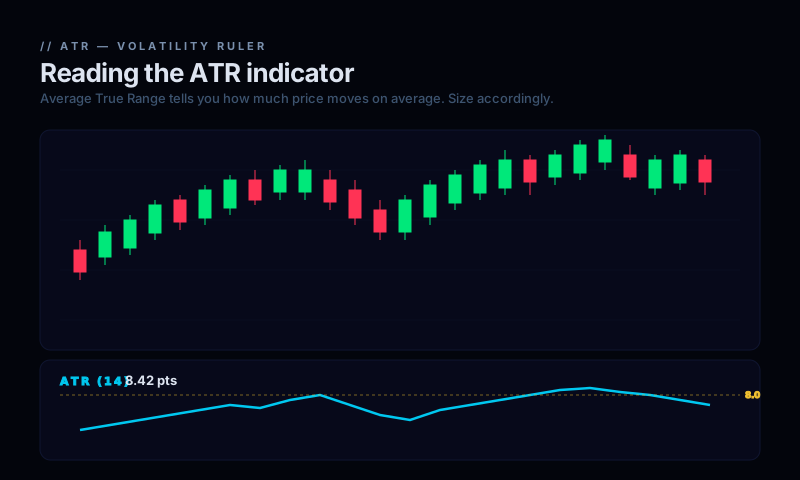
ATR(14) at 8.42 points means the average candle range is 8.42 points. Size accordingly.
ATR = Average True Range. It's a TradingView indicator that tells you, in plain numbers, how much an instrument has been moving on average over the last X periods.
If the 14-period ATR on ES (1-hour chart) is 8 points, that means: in the last 14 hours, ES has averaged 8 points of range per hour.
Now you can size intelligently:
- A "tight" stop = 0.75x to 1x ATR. ES with 8-point ATR → 6-8 point stop. Likely to get hit by normal noise.
- A "normal" stop = 1.25x to 1.5x ATR. ES with 8-point ATR → 10-12 point stop. Survives noise, exits on real adverse moves.
- A "wide" stop = 2x ATR. ES with 8-point ATR → 16 point stop. Very safe but requires smaller position size to keep risk at 2%.
GP signals already incorporate volatility-aware stops. But understanding ATR helps you decide whether the signal's stop makes sense for the current environment — which is a skill you build over time.
Adjusting size by session
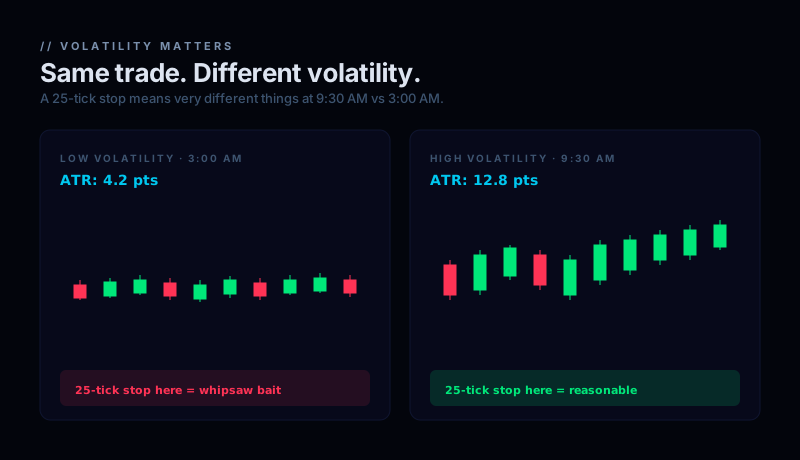
A 25-tick stop at 9:30 AM is reasonable. The same 25-tick stop at 3:00 AM is whipsaw bait.
Volatility isn't just different between assets. It's different at different times of day. Here's the pattern I've seen for years:
ES / NQ:
- 4:00-9:30 AM ET (pre-market): low volatility, thin liquidity, stops get hit on nothing.
- 9:30-11:00 AM ET (NY open): peak volatility, big ranges, real direction.
- 11:00-2:00 PM ET (lunch): chop. Lower conviction, smaller moves.
- 2:00-4:00 PM ET (close): second wave of volatility, often reversals.
BTC / Crypto:
- Asia session (8 PM - 4 AM ET): moderate, trend-driven.
- US session (8 AM - 4 PM ET): highest volatility, US flow.
- Weekends: thin, prone to weird moves.
How I personally use this: during high-volatility sessions, I take normal size. During low-volatility sessions, I either skip lower-conviction signals or size down 25-50%.
Rule of thumb: if a signal fires at 3 AM, ask yourself if the volatility supports the SL distance. If not, skip.
The drawdown adjustment — sizing down when losing
Every trader has losing streaks. The math says you'll have 4-5 losers in a row at some point even with a 60% win rate. That's just statistics.
What separates pros from amateurs is what they do during the streak.
Amateur response: "I'm due for a win." Sizes UP to "make back" the losses faster. Compounds the bleeding. Account dies.
Pro response: Sizes DOWN. Reduces psychological pressure. Lets the edge play out without breaking emotionally. Recovers slowly, then resumes normal size.
Here's the rule I follow:
After 3 consecutive losses → cut size to 1%
After 5 consecutive losses → STOP TRADING for the day
After 8 consecutive losses → STOP TRADING for the week. Review every trade.
This isn't about being scared. It's about being honest: when you're losing, something is off. Could be market regime change, could be you. Either way, the right move is smaller positions and more analysis, not bigger positions and more trades.
Sizing UP — when (and how) to do it correctly
I told you in Lesson 4 to never size up in your first 12 months. After that, here's how to do it correctly if you want to.
Don't increase risk per trade. Increase number of contracts as account grows.
This sounds like the same thing. It's not.
- Wrong: "My account is at $20k now, so I'll risk 3% per trade instead of 2%."
- Right: "My account is at $20k now, so 2% = $400 per trade, which means I trade 2 ES contracts instead of 1. Same risk percentage, larger absolute position."
This way, you compound naturally as the account grows. You never increase the percentage risk that's been keeping you safe.
Most traders blow up not by holding bad trades, but by increasing percentage risk after a winning streak. They think they've leveled up. Really they've just gotten lucky and are about to find out.
The "scaling in" technique
Once you've been trading the GP system for a while, you'll notice TP1 + TP2 setups give you a natural scaling-out exit. Some intermediate traders also experiment with scaling in.
Scaling in: entering a position in two pieces instead of all at once. Example: - Half size at signal entry (5,847.25) - Other half if price pulls back 3-5 ticks against you (5,844 area)
The benefit: better average entry price if there's a small adverse move before the trade works.
The cost: discipline. You need to commit to BOTH entries, even when the second one feels scary. Most traders chicken out on the second entry — making the technique pointless.
My honest take: scaling in is overhyped. The win rate improvement is small, and the discipline cost is real. Get good at single-entry sizing first. Add scaling in much later, if at all.
Position sizing in a volatile market
Sometimes the entire market regime shifts. VIX spikes, news drops, FOMC day, crypto crash weekend. The volatility you sized for last week is irrelevant.
Three rules for volatile environments:
- Reduce position size by 30-50% until you see how the new environment is behaving.
- Widen stops slightly OR shorten time horizon. Either give the trade more room, or take TP1 faster.
- Trade fewer signals, not more. High volatility tempts overtrading. Resist.
I've seen traders make their best year of returns in a calm market and then give it all back in three weeks during a vol spike. Don't be that trader.
What I want you to do this week
- Add the ATR(14) indicator to your TradingView charts on ES, NQ, and BTC. Get used to glancing at it before every trade.
- Track the next 10 GP signals. Note: was the SL distance reasonable for the ATR at the time?
- If you've had any consecutive losing streaks, audit them. Were you sizing too aggressively?
- Read Lesson 6 next: Stop Loss — The Error #1 That Kills Accounts.
Lesson 05 takeaways
- Fixed-tick stops ignore actual market volatility. ATR-based stops adapt.
- Sessions matter — size down or skip in low-volatility windows.
- Cut size after 3 losses. Stop after 5. Walk away after 8.
- Compound by trading more contracts at the same %, not by raising the %.
- High-volatility regimes require lower size, not higher.
See you in Lesson 6. — GP Trading Club