Why this lesson matters
If you read only one lesson in the entire Beginner module, make it this one. After almost a decade in this market, I can tell you with absolute certainty: risk management is what separates the 5% who survive from the 95% who don't.
Strategy doesn't matter if your risk is broken. The best signal in the world doesn't matter if your position size is wrong. This is the lesson new traders skip because it sounds boring. It's also the lesson that, if applied correctly, makes you bulletproof against the random losses every trader takes.
Read it slowly. This one matters.
The 2% rule, stated plainly
Never risk more than 2% of your account on a single trade.
That's it. That's the rule.
If your account is $10,000, the maximum you can lose on any single trade is $200. If your account is $5,000, your max loss is $100. If your account is $50,000, your max loss is $1,000.
The math doesn't care about how confident you feel, how high the signal score is, or how "obvious" the setup looks. 2% max. Per trade. Always.
Some pros use 1%. The most aggressive use 3%. Above 3%, you're not trading — you're gambling with extra steps.
Why 2% and not 5% or 10%?
Because of math. Specifically, the math of drawdowns.
Look at this table. It shows what percentage gain you need to recover from a given loss:
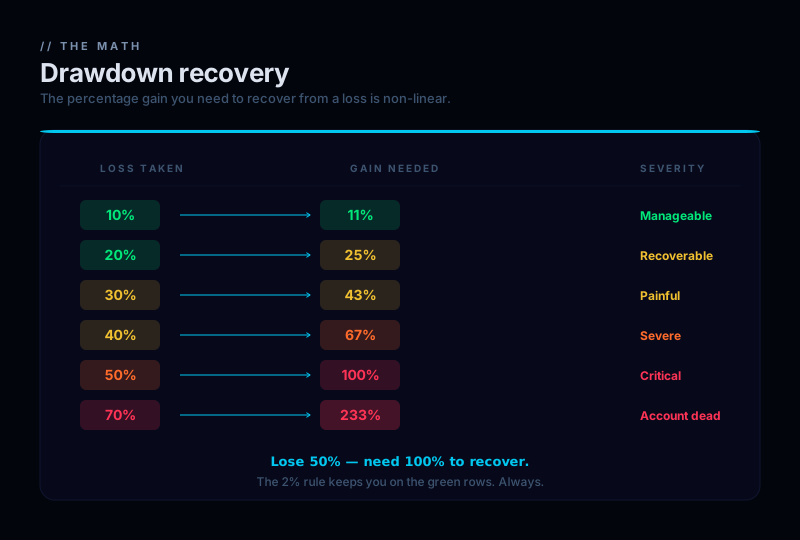
Lose 50% — need 100% to recover. The math punishes oversized positions exponentially.
Lose 50% of your account, you need a 100% return just to break even. That's a year of perfect trading wiped out by one bad week.
Now apply this to position sizing:
- At 2% risk per trade: You'd need 25 consecutive losses to lose 50% of your account. Statistically impossible if you have any edge.
- At 5% risk per trade: Just 13 consecutive losses puts you at -50%. Possible in a bad month.
- At 10% risk per trade: 7 consecutive losses = -50%. Happens to everyone eventually. When it does, you're done.
The 2% rule isn't about being cautious. It's about staying in the game long enough for your edge to play out.
How to actually calculate 2%
Here's the formula, once and for all:
Max Risk $$ = Account Size × 0.02
Position Size = Max Risk $$ / SL Distance per Unit
Example. You have a $10,000 account. You get a GP signal:
ES LONG | Entry: 5,847.25 | SL: 5,841.00Step 1 — Max risk in dollars: $10,000 × 0.02 = $200 max loss allowed
Step 2 — SL distance: 5,847.25 - 5,841.00 = 6.25 points = 25 ticks On ES, each tick = $12.50 per contract 25 ticks × $12.50 = $312.50 risk per contract
Step 3 — Position size: $200 / $312.50 = 0.64 contracts
Since you can't trade fractions of an ES contract, you'd either: - Skip this trade (size too big for your account), or - Trade the micro version (MES) — 1/10 the size, so $31.25 risk per contract. $200 / $31.25 = 6 micro contracts. ✅
This is exactly why micros exist. They let small accounts apply the 2% rule precisely.
Use the GP Risk Calculator. Every. Single. Trade.
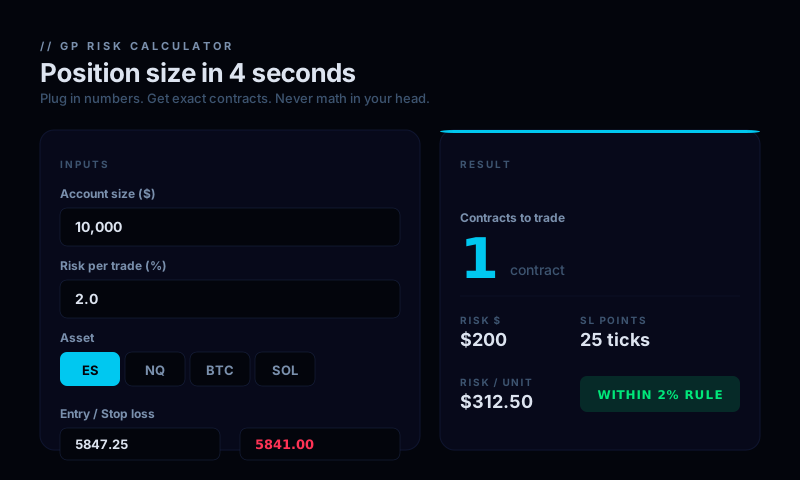
Plug in numbers. Get exact contracts. Never math in your head during the open.
You don't need to do this math in your head. The GP Risk Calculator on the platform does it for you. Plug in: - Account size - Risk % - Asset - Entry - Stop Loss
It tells you exactly how many contracts to trade. Use it. Even after a decade trading, I still plug numbers in for every signal. It takes 4 seconds and removes any chance of math error in the moment.
The traders who blow up are almost always the ones who "estimated" their position size in their head because the trade looked obvious. Don't be them.
What happens if you size wrong?
Two failure modes:
Oversized position (too many contracts): Your "small" -25 tick stop is now a -$1,000 hit on a $10,000 account. That's 10% gone on one trade. You take three more like that this week and you're at -30%. Now you're tilted, you start chasing, and the spiral begins.
Undersized position (too few contracts): You're "safe" but your wins are too small to grow the account. After 6 months you've made $200. You quit because "the system doesn't work." It does work — you just couldn't be patient at proper size.
The 2% rule lives in the middle. Big enough to compound. Small enough to survive.
When to size DOWN below 2%
Three situations where I personally use 1% instead of 2%:
- First 30 days on a new account. Build confidence in your execution before risking max.
- After 3 consecutive losses. Something is off — could be the market, could be you. Tighten up until you find your rhythm again.
- Trading a new instrument for the first time. Your first 10 NQ trades, your first 10 BTC trades — go small. You don't know how that instrument feels yet.
Sizing down is never wrong. Sizing up because you "feel hot"? Always wrong.
When to size UP — almost never
Some traders increase risk to 2.5-3% on signals scored 95+. I'll be honest: I don't recommend this for the first year. Even after a decade, I personally don't size up on score alone. The system already accounts for confidence in the score — your job is to take the trade at proper size, not second-guess the system by adjusting.
Rule for your first 12 months: every trade is the same risk percentage. Period.
The psychology of the 2% rule
Here's the real reason this rule works, beyond the math.
When you risk 2%, a losing trade is boring. You shrug, you log it, you wait for the next signal. No revenge trading. No emotional spiral. No tilt.
When you risk 10%, a losing trade is traumatic. You feel it physically. You check the chart for the next hour to see if you "should have held." You start hunting for the next setup with vengeance in your eyes. This is how accounts die — not from one bad trade, but from the cascade after one bad trade that was too big.
The 2% rule is psychological armor. Use it.
What I want you to do this week
- Open the GP Risk Calculator. Plug in 5 hypothetical signals at 2% risk and confirm you understand the contract math.
- On paper or demo, take 10 trades. Before each one, calculate position size with the calculator. Goal: it becomes automatic.
- Set your broker's max-loss-per-trade limit to your 2% number. Hard stop. Platform-enforced.
- Read Lesson 5 next (Intermediate Module): Position Sizing Advanced — Sizing by Volatility.
Lesson 04 takeaways
- Never risk more than 2% per trade. Ever.
- The math of drawdowns punishes oversized positions exponentially.
- Use the GP Risk Calculator on every single trade.
- Use micros (MES, MNQ) for small accounts to size precisely.
- Size down (not up) when uncertain. Sizing up is for traders who already wish they'd sized down.
See you in Lesson 5. — GP Trading Club