Why this lesson matters
When a GP signal hits your Telegram at 9:34 AM, you have about 15 seconds to decide. That's it. The price moves, the window closes, and the trade is gone. The traders who freeze? They lose to the ones who already know what every line means before the alert arrives.
This lesson breaks down a signal piece by piece so the next time one shows up, you act on muscle memory instead of panic.
What a real GP signal looks like
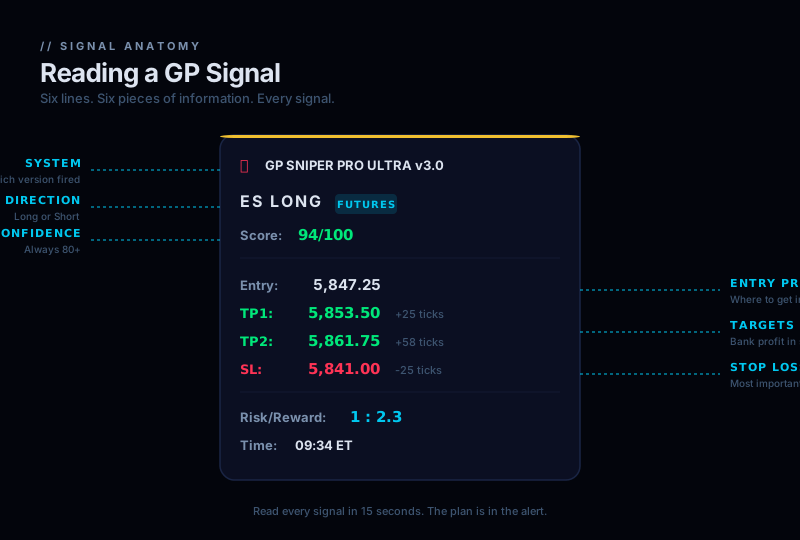
Six lines. Six pieces of information. Every signal looks like this.
Here's a typical alert you'll see on Telegram:
``` 🚨 GP SNIPER PRO ULTRA v3.0 ES LONG | FUTURES Score: 94/100
Entry: 5,847.25 TP1: 5,853.50 (+25 ticks) TP2: 5,861.75 (+58 ticks) SL: 5,841.00 (-25 ticks)
Risk/Reward: 1:2.3 Time: 09:34 ET ```
That's it. Six pieces of information. Every signal you'll ever get follows this exact structure. Let's go through each one.
Line 1 — The system signature
GP SNIPER PRO ULTRA v3.0 tells you which version of our system fired the signal. Why does this matter? Because not every signal is created equal. Different systems have different setups, different historical win rates, different ideal market conditions. Over time you'll learn which signature performs best in which environment.
For now, all you need to know is: trust the system that's named in the alert. It fired for a reason.
Line 2 — Asset and direction
ES LONG | FUTURES
Three pieces of info packed in one line:
- ES — the instrument. Could be NQ, BTC, ETH, SOL, or XRP.
- LONG — the direction. Buy now, profit if price rises.
- FUTURES — the asset class (vs CRYPTO).
If you see SHORT instead of LONG, you sell first and buy back lower. Don't overthink it. The system already decided.
Line 3 — The score
Score: 94/100
This is the system's confidence level. Every signal we send scores above 80 — below that we don't even publish it. But within the 80-100 range, higher is meaningfully better.
How I personally use it after years of taking these:
- 80-89 — Standard signal. I take it with normal size.
- 90-100 — High-conviction signal. I take it with normal size and pay closer attention to managing the trade. Some traders increase size slightly here. That's a personal choice — most beginners shouldn't.
Never increase size beyond your risk rules even on a 100/100 score. The 2% rule doesn't care about confidence. We'll cover this in Lesson 4.
Line 4 — Entry
Entry: 5,847.25
This is the exact price at which the signal triggered. Two scenarios when you act on it:
Scenario A — Price is still at or near entry: Take the trade at market or with a limit order at the entry price. Acceptable slippage: 1-2 ticks on ES, 1-2 points on BTC. More than that, skip the trade.
Scenario B — Price has already moved significantly past entry: Skip the signal. Chasing is the #1 way new traders lose. If ES is now at 5,851 when the signal said entry was 5,847, the risk-reward is broken. The trade is no longer the trade. Wait for the next one.
There's always another signal. Always.
Line 5 — Take profit (TP1 and TP2)
TP1: 5,853.50  (+25 ticks)
TP2: 5,861.75  (+58 ticks)
Two profit targets, not one. Here's how I use them:
TP1 = first profit zone. Close 50-70% of your position here. This pays for the trade and locks in a winner. Even if the market reverses, you walked away green.
TP2 = the runner. Let the remaining 30-50% ride toward TP2 with a stop moved to break-even. If TP2 hits, big winner. If it reverses, you exit at break-even with TP1 already banked. You literally cannot lose money on this trade anymore.
This two-stage exit is the difference between traders who scrape pennies and traders who let their winners run. Most beginners take all profit at TP1 and never see TP2 hit. Don't be that trader.
Line 6 — Stop loss
SL: 5,841.00 (-25 ticks)
The single most important number on the entire signal. The price at which you exit if the trade goes against you.
Three rules I cannot stress enough:
- Set the SL the moment you enter. Not 30 seconds later. Not after you "see how it goes." The moment you enter. Use a stop order at your broker — let the platform protect you, because in the moment, you won't.
- Never move the SL further away. Ever. If price approaches your stop, the trade is wrong. Moving the stop is admitting the original trade was wrong AND making it worse. This is how accounts die.
- You CAN move the SL closer (toward break-even) once price moves in your favor. This is called "trailing." Smart. Recommended after TP1 hits.
If you remember nothing else from this lesson, remember rule #1. Set the stop. Always.
Line 7 — Risk/Reward ratio
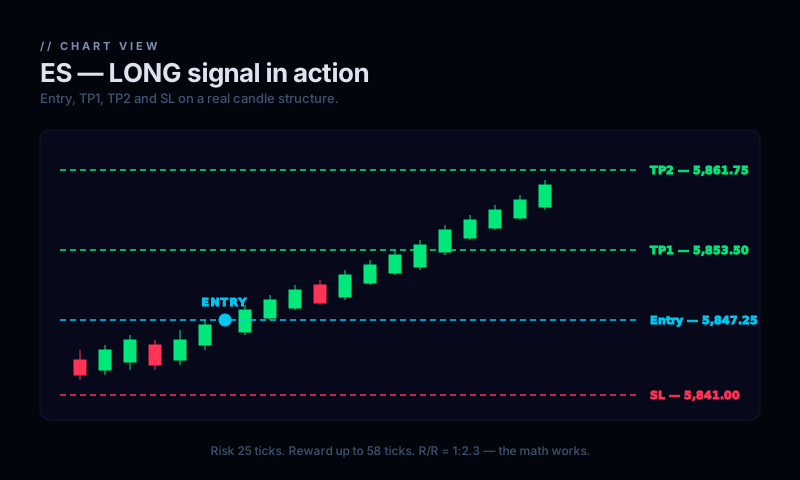
The same signal plotted on the chart. Risk 25 ticks. Reward up to 58 ticks. R/R = 1:2.3.
Risk/Reward: 1:2.3
This is the math that makes the system profitable even at 50% win rate.
- You risk 25 ticks (the distance from entry to SL)
- You target 58 ticks (the distance from entry to TP2)
- Ratio: 58/25 = 2.3x
If you're right 50% of the time at 1:2.3 R/R, you're profitable. The math doesn't care about how you feel that day.
Never take a GP signal with R/R below 1:1.5. We don't publish those, but if you ever calculate one yourself and it's below that, skip it. The math has to work.
A 15-second decision framework
When the alert hits, ask yourself in this order:
- Is price still within 1-2 ticks of entry? If no → skip.
- Have I set my position size based on the SL distance? (Lesson 5 covers this.) If you can't size correctly in 5 seconds, don't take the trade.
- Is my SL set in the broker the second I'm filled? If you can't do that, don't take the trade.
Three questions. Yes-yes-yes → trade. Anything else → next signal.
What I want you to do this week
- The next 5 GP signals that come in, don't trade them. Just paper trade or watch. Walk through each one with this framework.
- Time yourself: from alert receipt to "would I take this?" decision. Goal: under 15 seconds by the end of the week.
- Lesson 3 next: Your First Account — Brokers and Platforms. Once you can read a signal, we'll set up where you'll execute them.
Lesson 02 takeaways
- Every GP signal has the same 6-line structure
- Score tells you confidence, not size — keep your risk rules
- Set the SL the moment you enter. Never move it further. Trail it closer.
- Use TP1 + TP2 to bank profit AND let runners run
- Skip any signal where price moved too far past entry — there's always another
See you in Lesson 3. — GP Trading Club